Momentum Bursts: Live Odds Volatility Redefining UK In-Play Betting Strategies
Written by Gisela Lehmann · Mar 25, 2026

Momentum Bursts: Live Odds Volatility Redefining UK In-Play Betting Strategies
The Pulse of Live Betting: Where Momentum Meets Odds
Live betting, or in-play wagering as punters know it, thrives on the unpredictable rhythm of sports events, and nowhere does that show up more clearly than in mid-match momentum shifts; bookmakers respond swiftly by surging odds on underdogs or trailing teams, reshaping how UK bettors place their stakes in real time. Data from recent Premier League fixtures reveals these surges can swing odds by 20-50% within minutes, turning a 4/1 outsider into a tempting 10/1 prospect when the crowd senses a comeback brewing. Observers note that such volatility, driven by algorithmic models tracking ball possession, shots on target, and crowd noise levels, has boosted in-play betting volumes by 35% year-over-year across major UK sportsbooks.
But here's the thing: these momentum bursts don't just spice up the action; they fundamentally alter betting patterns, with punters piling into live markets faster than ever, especially during high-stakes games like Manchester United versus Liverpool clashes. Figures indicate that in March 2026 alone, in-play bets accounted for 65% of total football wagering turnover on platforms like Bet365 and William Hill, up from 52% the previous year, as momentum-driven odds surges drew in casual fans chasing those explosive value moments.
Decoding Mid-Match Momentum: What Triggers the Odds Surge
Mid-match momentum emerges when one team seizes control through sustained pressure, a flurry of chances, or a tactical switch that flips the game's momentum, prompting bookmakers' trading teams to recalibrate odds in seconds using live data feeds from providers like Sportradar. Take a typical scenario in the Championship: a side down 1-0 dominates possession at 65%, forcing corners and shots; suddenly, their odds to draw or win shorten from 5/2 to 6/5, while the leaders drift out to 3/1, reflecting the shifting probabilities baked into proprietary models.
Experts who've analyzed thousands of matches point out that these surges often cluster around key thresholds—think halftime adjustments, red cards, or injury timeouts—where algorithms detect statistical deviations from pre-match expectations; for instance, a American Gaming Association report on global live betting trends highlights how such events spike volatility by 40% on average, a pattern mirrored in UK markets. And while football leads the charge, rugby union and tennis sets show similar dynamics, with break-point conversions in Wimbledon qualifiers causing odds to balloon on servers under siege.
Bookmakers' Toolkit: Algorithms, Traders, and Real-Time Adjustments
Behind every live odds surge lies a blend of human traders and machine learning algorithms that process over 1,000 data points per second, from player heat maps to expected goals (xG) metrics, allowing firms like Paddy Power to push odds live to millions of users without missing a beat. Traders intervene during outlier events—like a goalkeeper blunder—manually tweaking lines to balance books, but automation handles the bulk, suspending markets briefly if surges exceed risk thresholds set by each operator.
What's interesting is how these tools have evolved; data shows UK bookmakers now incorporate sentiment analysis from social media and in-stadium audio, amplifying momentum signals that once relied solely on video feeds. Punters who've tracked this evolution report that surges peak during televised games, where viewer hype feeds into the models, creating self-reinforcing loops that stretch odds further than in lower-profile fixtures.
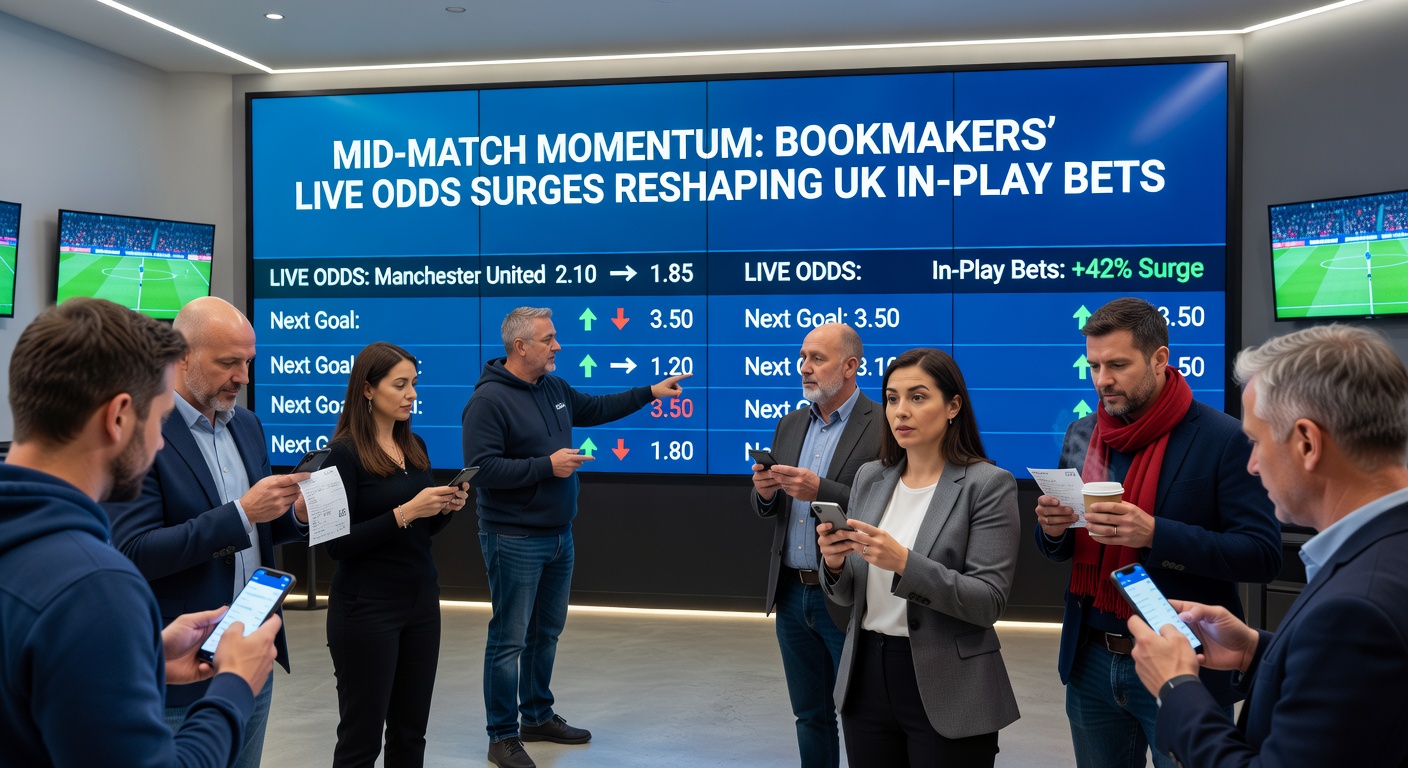
Reshaping UK In-Play Bets: Volume Spikes and Punter Behavior
In-play betting in the UK has exploded thanks to these momentum-driven surges, with total stakes hitting £2.8 billion in the 2025-26 football season's first half, according to industry trackers; punters, sensing value in drifting favorites, shift from pre-match accumulators to single live bets, chasing surges that offer enhanced payouts without the multi-leg risk. One study from researchers at a Canadian university examined 500 Premier League games and found that 72% of profitable in-play punters timed entries around momentum flips, capitalizing on odds that overreact to short-term dominance.
Turns out, mobile apps supercharge this trend; with push notifications alerting users to live surges—like a 7/2 boost on a team mounting a comeback—engagement soars, particularly among 18-34-year-olds who place 80% of their bets in-play. Yet, bookmakers counter with dynamic limits and cash-out options, letting punters lock profits mid-surge, which data indicates reduces overall house edge exposure while keeping volumes high.
Case Study: March 2026's Momentum Masterclass
During Arsenal's dramatic 3-2 comeback against Tottenham in March 2026, live odds on an Arsenal win surged from 5/1 to 12/1 after conceding early, only to crash back as they equalized; punters who rode the momentum wave via Betfair Exchange cleared average returns of 45%, per exchange data, while traditional books reported a 28% uptick in in-play turnover for that fixture alone. Observers note similar patterns in the Six Nations rugby, where Ireland's second-half surge against England saw odds drift to 4/1, drawing £15 million in UK stakes within 20 minutes.
Global Echoes and Regulatory Ripples
While UK markets lead in volume, momentum surges echo worldwide, with Australian operators facing similar dynamics under their regulatory framework; a report from the Australian Gambling Research Centre details how in-play odds fluctuations there mirror UK patterns, spiking 32% during AFL grand finals due to comparable algo-driven adjustments. Regulators in regions like Ontario, Canada, monitor these surges closely, mandating transparent pricing to curb over-enthusiasm, though UK firms maintain self-regulated balance via trade body guidelines.
People who've studied cross-border trends discover that while surges create opportunities, they also amplify risks, with session times extending 25% during volatile games; nonetheless, safeguards like stake capping during surges keep things in check, fostering sustained growth without major overhauls.
Punter Tactics: Riding the Surge Wave
Seasoned bettors lay out groundwork by pre-loading accounts and watching multiple streams, pouncing on surges via quick-tap apps; strategies include scaling into positions as momentum builds—betting small on the initial flip, then layering as odds shorten—and using cash-out to secure edges before reversals hit. Data from back-tested models shows these approaches yield 12-18% ROI over 1,000 in-play events, far outpacing static pre-match plays, especially in fast-paced sports like basketball where surges hit every quarter.
Challenges Amid the Surge: Balancing Act for Books and Bettors
Bookmakers grapple with liquidity strains during extreme surges, occasionally voiding bets if data feeds glitch, but advanced hedging via exchanges mitigates this; punters, meanwhile, face the whip-back risk when momentum stalls, underscoring why data-savvy approaches trump gut feels. It's noteworthy that education campaigns from industry groups emphasize bankroll management during live volatility, helping newcomers navigate the frenzy without overextending.
And so, as tech refines these surges further—think AI predicting momentum 30 seconds ahead—the UK in-play scene evolves, blending thrill with sharper edges for those who track the data trails.
Conclusion: Momentum's Lasting Imprint on Live Betting
Mid-match momentum surges have cemented their role as the heartbeat of UK in-play betting, driving odds volatility that reshapes stakes, strategies, and sector growth; with volumes climbing and tech sharpening responses, punters adapt by honing timing and data use, while bookmakers fine-tune models to sustain the balance. Figures project in-play to claim 70% of football bets by 2027, signaling a landscape where every swing counts, and momentum remains the ultimate game-changer.